
Last week I visited colleagues that continue to work at my former department. I and others had our affiliations severed following the restructuring of SBCS in 2012. My trip coincided with the publication of the names of individuals (and their contributed papers) representing SBCS in a major UK government evaluation, known as the REF. It is therefore unsurprising that conversations centred, amongst other things, to an evaluation of the REF outcomes for the department and the effects the restructuring had on its performance. Some of the comments I heard are difficult to transmit without placing valued colleagues or myself at risk of further reprisals. In this category I place important matters such as the wellbeing (health) of friends who have been put under “performance management” or subjective views on the dramatic shift in what is being valued and rewarded within the restructured department.
Category: Academic
New facet of scientific illiteracy
In Mexico, bean-counting is also referred to as puntitis (Jorge Quevedo) or cuentachilismo (Marcelino Cereijido). My local colleague and celebrated author has created with his student Claudia Edwards a three-paragraph gem on the stupidity of bureaucratic managerialism in science. You can read it in Spanish here. The text is so good that I have translated the 5 concrete examples of “modern” stupidity below. The international reader will instantly see that the crisis Pirincho (as Marcelino is also known to his friends) describes is by no means a “third world” problem.
Innocent spin inviting a laugh or public display of dishonesty?
I wrote in August 2012
It is time… to intervene and force a change in leadership at Queen Mary. Otherwise, future generations will learn by example that those who disrespect academic integrity are rewarded with university title and published fanfare in the academic press
If scientists knowingly spin an incorrect statement into the title of a paper and present a misleading finding of fact, qualified in footnote with reference to a table, the table showing that title, finding and footnote do not stand to scrutiny, what happens to their reputation?
I ask here again if science and modern university management are presently in conflict. The question follows what Queen Mary management has published in the University’s website:
Jeremy Kilburn quits Queen Mary
In 2007, I started on my first independent position in the School of Biological and Chemical Sciences at Queen Mary University of London. Two years later Sir Nicholas Montagu was appointed Chairman of Council and Simon Gaskell was appointed Principal of the University. They formulated a strategic plan with the explicit aim to rank QMUL in the UK’s top-ten list according to the Government’s Research Excellence Framework assessment.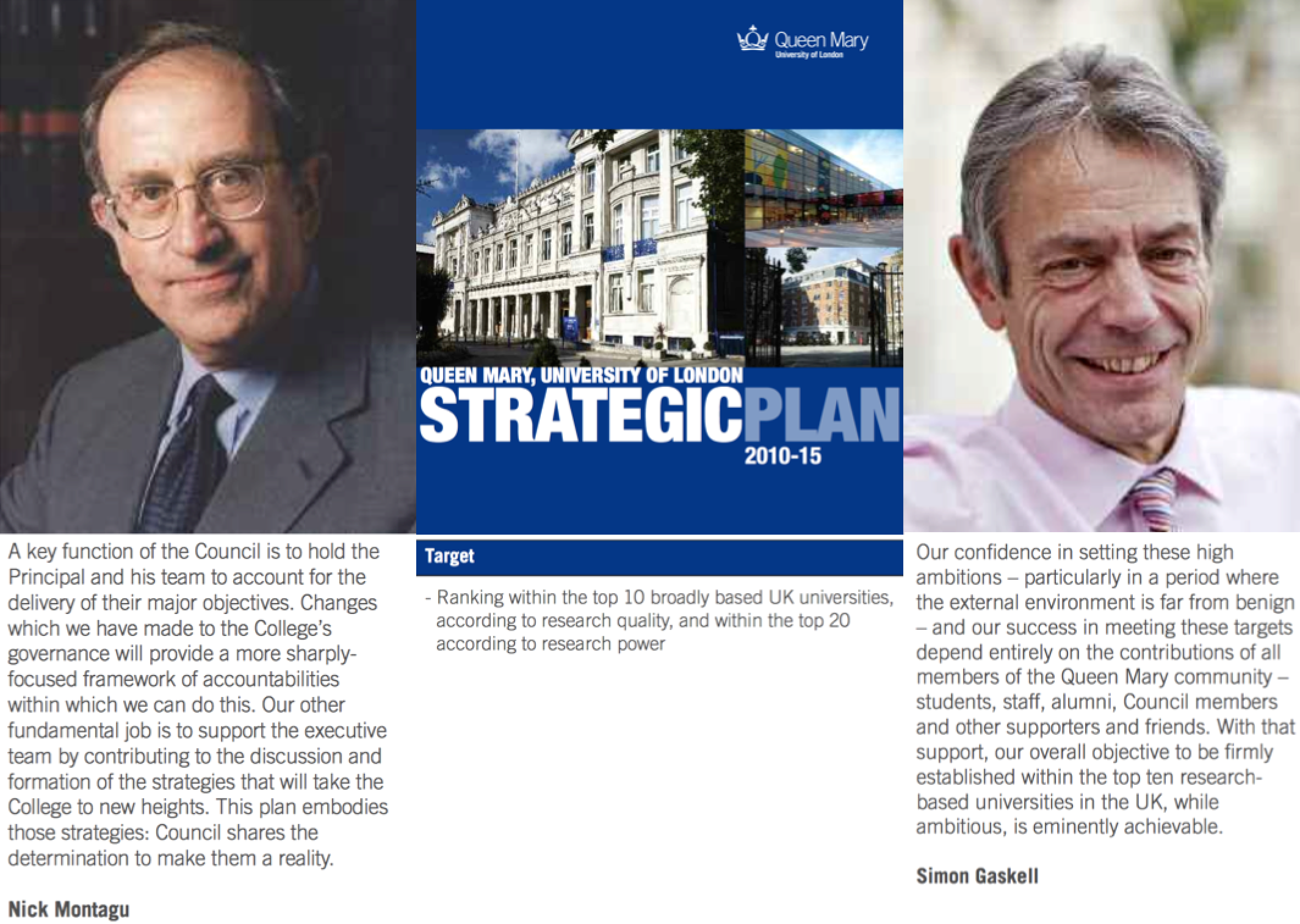
Preparing for the big day
REF probably means little or nothing to scientists around the world, unless they work in Britain. This is the final week, prior to the preliminary announcements of the Research Excellence Framework (REF) “assessment outcomes”, which “will inform the selective allocation of research funding” and “provide benchmarking information and establish reputational yardsticks“. Are you REFable or a REFugee? asks THE editor John Gill. He would probably classify me to the latter category 🙂 Yet, Lord Stern of Brent, President of the British Academy and Sir Paul Nurse, President of the Royal Society have raised questions:
Has what was designed as an instrument of quality assessment become an institution that risks stifling the excellence it was intended to foster?
How Professors are treated at Imperial College
This is the title of an e-mail by Stefan Grimm sent on 21 October 2014 – less than 19 minutes before midnight.
The full email is published by David Colquhoun’s Improbable Science “as a public service”:
Publish and perish at Imperial College London: the death of Stefan Grimm
Stefan Grimm, RIP
Moonlighting proteins. “The idea of one gene—one protein—one function has become too simple because increasing numbers of proteins are found to have two or more different functions.” [Constance J. Jeffery, 1999, Trends in Biochemical Sciences]
A Physicist’s dream
A moment to share, as an outsider observer to a warm celebration of a Polish contributor to the exact sciences with a working base shared between Mexico City and Warsaw during the past 50 years:
Ophiocordyceps unilateralis
I first heard about the “zombie fungus” from Robin Maytum when we were working together at Queen Mary. The story captivated my imagination: The fungus infects an ant, eats up most of its interiors, leaving intact a few key neurons and muscles. Once its feast is done, the fungus can still control the ant’s locomotion, which then moves on to a leaf from where the fungus can best spread out its spores.
If you are the ant, you are unlikely to hold Ophiocordyceps unilateralis high in your esteem, even more to befriend it. Robin was the first cell within the infected ant I encountered. Other tissues were quite unprepared for the infection and so our university (the ant) was overtaken by those fungus-like managers. I have not stopped telling that story ever since.
A few reminders of what Restruction is all about.
Restruction is “dESTRUCTION by means of a Restructuring exercise”.
 fanismissirlis