

Simon Gaskell has announced with an email to all staff his retirement. This is good news for the College, although it will be challenging to find a successor to reverse such decline witnessed in the past few years. Together with the departures of Matthew Evans and Jeremy Kilburn, none of the culprits of the destruction of the School of Biological and Chemical Sciences remains in post. As I put it to Gaskell in November 2011: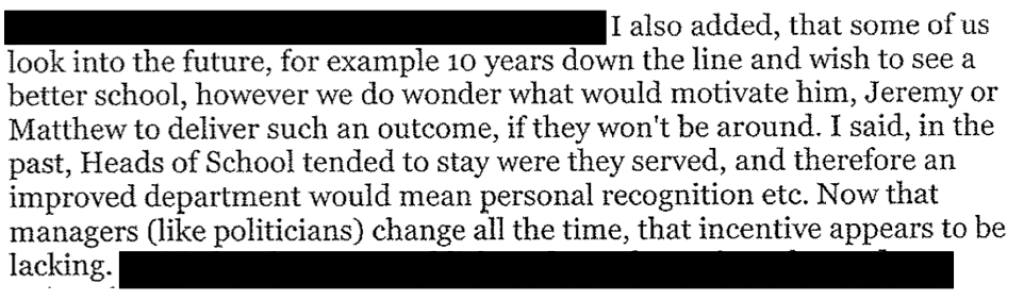
Correspondence with Sir Nicholas Montagu
Sir Nicholas Montagu, Chairman of Council, Queen Mary University of London
Simon Gaskell, Principal and President, Queen Mary University of London
Petition to reinstate John F. Allen at Queen Mary University of London
Simon Gaskell unlawfully dismissed Professor John Allen in the aftermath of the restructuring of the School of Biological and Chemical Sciences at the College.
You can read the Employment Appeal Tribunal Judgment here: http://www.bailii.org/uk/cases/UKEAT/2016/0265_15_1104.html
In my view, you are under the moral obligation to repair the damage of this decision before you quit formally your respective posts at the College.
I request a reply to this open petition.
Yours sincerely,
Fanis Missirlis

Dr C Magoulas v QMUL (part III)
If you need background to this dispute read first part I. For my general commentary on the case see ‘Academic position, age discrimination and social justice‘. If you would like to know how Queen Mary failed to follow its own Redeployment Procedure when dismissing Babis see part II. Here, I comment on three (of the four) final (summary) points in the Employment Appeal Tribunal Judgment (paragraphs 34-36). (more…)
Espiritu libre
A promising 80-years-old young man. Presentation of the special issue of avance y perspectiva dedicated to Bogdan Mielnik.

Dr C Magoulas v QMUL (part II)
This post continues an account and critique of the EAT Judgment
“The Tribunal’s Decision on the Application for Reconsideration
21. The Claimant applied for a review. The ET refused that application because there was no reasonable prospect of the decision being varied or revoked. The application had been based on a “new finding of fact” in the decision of a different ET in a different case. The ET held that the new evidence would not probably have had an important influence on the outcome. That is not challenged on this appeal.”
Reading the above one may ask: what was the “new finding of fact”? And how come the ET [Employment Tribunal] held that the new evidence would not probably have had an important influence on the outcome? I pause to consider this issue. It relates to the failure of QMUL to enact its redeployment procedure as required by employment law in a redundancy situation. (more…)
Simon Gaskell should reinstate John Allen
Simon Gaskell should reinstate John Allen to his post at Queen Mary. It is the right thing to do after the Employment Tribunal’s findings that John’s dismissal was unfair. The Tribunal found that removing the whole of the John’s pre-sabbatical work was such a serious breach of contract that, taken together with the failure to deal with his grievance in a reasonable time, it would have justified resignation and a constructive dismissal claim. (more…)
The East End of London
The “Legend” is a movie about the Kray brothers and their influence on East London. “The College” is located at the heart of it all and still has a collective memory around the mark left by the Krays…
Academic position, age discrimination and social justice
Dedicated to the memory of Jake Dutton, barrister and member of Clerksroom, who represented Babis Magoulas at the Employment Appeal Tribunal.
Matthew Evans quits Queen Mary
With two tweets, Prof Matthew Evans announced his notice to Queen Mary University of London, standing down on July 1st, 2016. His departure follows that of Prof Jeremy Kilburn. I once shared with the Principal of Queen Mary my view that because managers (like politicians) change all the time, the incentive to build an improved department (which in former times would mean personal recognition) appears to be lacking. Indeed, this pair of managers deeply transformed the School of Biological and Chemical Sciences: in a blink of an eye they recruited over 50 new academics who joined 40 members of staff surviving since 2011, while effecting 35 departures of active researchers. Was it for the better? I think Prof Evans would say so:
 fanismissirlis